
Pain and discomfort are intrinsically subjective experiences, which makes them difficult to express, the privacy of pain and lack of a clear point of reference can make precise, literal description particularly difficult[1]. Personally, I rarely have the words to describe my pain or discomfort right away. Instead, I typically use the only script that appears to be available: I'm fine, a polite wall constructed naturally over a sensation that has yet to register.
I started to recognise a similar challenge when thinking about intimate medical examinations, such as pelvic exams, colposcopy, hysteroscopy, Intrauterine Device (IUD) insertion, breast and chest examinations, cervical exams, and smear tests, where pain, discomfort, and other bodily sensations become difficult to express. This challenge has become central to my research on patient-clinician communication during intimate examinations. But it has also led me to a different question than I had imagined. I began with a familiar question: how can we improve communication in this space? But the more I reflect on the experience of intimate examinations, the more I question if better communication is the answer. What happens if, instead of immediately trying to resolve this challenge, we stay with it for a while?
Philosopher Drew Leder describes in The Absent Body how the body often recedes from conscious awareness in everyday life, a process he calls ‘dis-appearance’.[2] We hardly pay attention to our breathing, posture, or internal bodily functions until pain, illness, injury, or disruption calls the body back into attention. Leder refers to this return of the body through dysfunction or discomfort as ‘dys-appearance’.[3] This concept is highly present in intimate examinations. Here, the body becomes the very centre of attention, it is exposed, touched, positioned, examined and interpreted. The patient is suddenly intensely aware of sensations, movements, and bodily boundaries that would otherwise go unnoticed. Yet this heightened awareness does not necessarily make bodily experiences easier to understand or describe. In fact, it may do the opposite. Rather than one distinct sensation, the patient may experience many at once; such as the coldness of a speculum, pressure, stretching, vulnerability, fear, uncertainty, or a sense of being watched.
There's something particular about lying vulnerable on an examination table and negotiating the unfamiliar choreography of a clinical environment. Women undergoing pelvic examinations often describe experiences of exposure, loss of control, embarrassment, anxiety and physical discomfort, including the sensation of a cold instrument.[4] Even in discomfort, the patient is often expected to participate, move when asked, answer questions, relax, breathe, remain still, or express symptoms clearly. At that moment, my own mind is often occupied with more immediate questions. Can I put my clothes back on now? Is it over? Should I say something? What happens next? There is very little room to reflect, understand, or communicate while the body is managing touch, exposure, vulnerability, and uncertainty all at once.
In clinical encounters, discomfort, uncertainty, and vulnerability are often treated as problems to be managed, minimised, or resolved. Protocols enable clinicians to perform procedures safely, get consent, and reassure patients. Certain biological states become evident and interpretable through medical technologies; a scan can disclose an enlarged ovary, a measurement can track progress, and a diagnosis can define an experience. However, these forms of visibility do not necessarily capture the entirety of what a patient experiences during an intimate examination.
Furthermore, the language used during these encounters may not align with the patient's experiences. A clinician may say, You might feel some pressure, while the patient may feel something far more complex, such as coldness, sharpness, panic, embarrassment, dissociation, numbness, or pain, whilst another patient may feel very little. The same phrase may therefore be both correct and insufficient, depending on the body, the situation, and the context in which it is delivered.[5] This is not a criticism of clinicians, who frequently operate within limited systems and time constraints. Nor is it a claim that clinical language fails. Rather, it raises a different question; is our understanding of communication sufficient to accommodate everything that occurs in the examination room?
Donna Haraway’s Staying with the Trouble Making Kin in the Chthulucene challenges the temptation to seek clean solutions to complex situations. Rather than rushing to resolutions, she encourages us to be present, attentive, and connected to the conditions and relations that shape the world around us.[6] Her work also questions the notion that humans exist independently of the material world, acknowledging that we are entangled with other beings, technologies, and the environment.
I find this particularly interesting for my research. What if we refused the notion that discomfort, uncertainty or ambiguity can be easily resolved, and we stayed with them to understand what they might reveal. This means resisting the urge to design a new technology to remove pain and discomfort or translate sensations into interpretable forms. It also means questioning how bodily experiences are designed for within healthcare systems. While pain scales, consent forms and clinical records are essential for patient care and offer useful ways of documenting and communicating bodily experiences. What happens when they cannot exhaust the entirety of the experience? A patient might rate their pain from one to ten while struggling to sufficiently articulate the combination of sensations and experiences that the encounter produced. Research on pain language similarly suggests that single-word measures are inadequate for capturing the complexity of pain experience, which people often express through metaphor.[7] My research explores these experiences that remain difficult to quantify or visualise. Staying with the trouble, then, does not mean accepting discomfort as inevitable. It does not mean overlooking pain, dismissing concerns, or arguing that intimate examinations should not be improved. It means resisting the urge to rush toward solutions before we have attended to the conditions, relationships, and experiences that make these encounters what they are. One way I have begun to stay with the trouble of these experiences is by asking who or what participates in an examination.
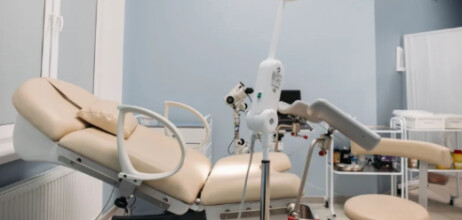
Beyond the patient and clinician, there is the speculum, gel, paper sheet, examination table, screen, probes, lights, gloves, bodily fluids, tissues, and the equipment. There's also the space itself, which includes the temperature, layout, sounds, smells, and rhythms. These are not just background details. They actively shape how the examination proceeds and what is possible inside it. A cold instrument can alter the experience of an examination before a doctor has stated anything. A paper sheet or gown can create a particular relationship around exposure, and bodily boundaries. An ultrasound screen makes the internal bodily state visible while drawing attention away from other aspects of the patient's experience. The room’s layout and setting can also determine whether a patient feels comfortable enough to communicate. Hence, these materials and technologies participate in shaping the encounter, making communication an interaction between more than the patient and clinician.
This is where a more-than-human perspective becomes essential to my research. It describes an approach that recognises the world as not made exclusively of humans. Human life is inextricably intertwined with animals, plants, microorganisms, objects, and technologies, all of which can influence how we feel, communicate, know, and act. A more-than-human approach allows me to explore how these relationships continuously shape communication during intimate examinations.
My research therefore aims to move beyond a verbal, human-centred understanding of communication. Instead it approaches communication during intimate examinations as entangled with the body, touch, sensation, silence, material objects, and clinical environments. This also means attending to different bodies and identities. Bodies carry different histories, identities, and relationships to healthcare which shape how someone experiences an intimate examination. Experiences in an intimate health encounter cannot be adequately understood through a universal account of the patient. Exploring these differences requires attention to the social, cultural, and material conditions that shape those encounters.
I do not think the answer is to abandon efforts to improve communication during intimate examinations. Clear communication, trauma-informed care, patient agency, and sensitive clinical practice all matter. But improvement cannot begin with the assumption that every challenge can be solved through a better phrase, a shorter waiting time, or a more efficient procedure. Sometimes the most important work is to observe what is difficult, uncertain, or difficult to describe; to recognise the role of the material life, environment, and technology; and to allow for experiences that do not fall neatly into clinical categories.
Staying with the trouble means allowing discomfort to be significant rather than viewing it as an obstacle to be resolved. It means paying attention to what is happening beyond the verbal exchange. Maybe communication during intimate examinations is more than just using the appropriate words. It is about recognising that a patient's experience goes beyond what can be observed, recorded or articulated in the examination room. And perhaps it is also about creating conditions in which patients do not have to immediately reach for I'm fine.
Notes
[1] Adriana Joanna Mickiewicz, ‘How Do We Understand the Pain of the Other? The Role of Imagination in the Verbal Communication of Physical Pain’, Medicine, Health Care and Philosophy [published online ahead of print 14 October 2026].
[2] Drew Leder, The Absent Body (Chicago: University of Chicago Press, 1990), p. 27.
[3] Leder, The Absent Body, p. 90-1.
[4] Skär, Lisa, Olov Grankvist, and Siv Söderberg, ‘Factors of Importance for Developing a Trustful Patient-Professional Relationship When Women Undergo a Pelvic Examination’, Health Care for Women International, 41.8 (2020), 869–82.
[5] Jose Carugno and others, ‘Impact of Using Words with Unpleasant Emotional Connotations on Perceived Patient Discomfort during Vaginal Speculum Examinations: A Randomized Controlled Trial’, European Journal of Obstetrics & Gynecology and Reproductive Biology, 247 (2020), 203–06 (204).
[6] Donna J. Haraway, Staying with the Trouble: Making Kin in the Chthulucene (Durham, NC: Duke University Press, 2016), p. 45.
[7] Imogene Munday, Ian Kneebone, and Toby Newton-John, ‘The Language of Chronic Pain’, Disability and Rehabilitation, 43.3 (2021), 354–61 (356).
* Article image at Pexels Photographer Pavel Danilyuk

Ifeoma Irene Njoku (She/Her) is a PhD Student at University College Dublin. Her research area is Researching Patient-Clinician communication during intimate examination. Ifeoma is the winner of the Poster Competition at the IHA annual conference 2026 - Unsilencing Healthcare at South East Technological University.
Published: 9 Nov 2026 Categories: Emerging Scholars