Ireland’s War of Independence (or Anglo-Irish War), which commenced at Soloheadbeg on 21 January 1919, was a guerrilla war fought by the flying columns of the Irish Republican Army (IRA) against the forces of the British government. The conflict ended with a truce on 11 July 1921. This was followed by the signing of the Anglo-Irish Treaty on 6 December 1921 and the legal enactment of the Irish Free State (Saorstát Eireann) on 6 December 1922. A new Constitution came into effect on 29 December 1937, under which the Free State was renamed Éire/Ireland. It left the British Commonwealth and became a Republic on Easter Monday, 18 April 1949. From 2019–2021, the centenary anniversary of the War of Independence was commemorated by a wide range of in-person and online events. Although impacted by the Covid-19 pandemic, the public response to the centenary was characterised by significant levels of historical enquiry, cultural engagement, and creativity – featuring input from the government, local authorities, higher education institutions, and local communities.
This blog focuses on the making of a heritage trail about the killing of brothers Harry (Henry) and Pat (Patrick) Loughnane in 1920. The brothers, who lived in Shanaglish village in south County Galway, were prominent members of the local Sinn Féin organisation. They also played with Beagh GAA Club’s hurling team. Pat, aged 29, was the full-back and Harry, aged 21, was the goalkeeper. Pat served with the IRA during the War of Independence. He was a suspect in an engagement with the Royal Irish Constabulary at Blackwater, Gort on 12 September 1920, in the Castledaly Ambush on 30 October 1920, and in a raid on the residence of a retired policeman on an unknown date.
On Friday 26 November 1920 – which was five days after Bloody Sunday and two days before the Kilmichael Ambush – the Loughnanes were captured by British forces at their family farm in Shanaglish. Afterwards, the brothers suffered a horrific ordeal of violent torture and were shot dead at a secluded spot at Moy O’Hynes’ Wood (midway between Kinvara and Ardrahan) by the Auxiliaries, who were a paramilitary unit of the police. The bodies were then burnt, before being deposited in a turlough at Owenbristy, which is also known locally as Umbriste or Dombriste. The brothers’ deaths serve as a vivid reminder of the brutality endured by people during one of the most harrowing phases of the War of Independence. During the month of November 1920, there was a considerable escalation in the levels of violence on both sides of the conflict, with killings often followed by reprisals.
Tomás Ó hEidhín’s gruesome photographs of the badly mutilated remains of the brothers in open coffins garnered considerable international attention and turned the brothers into republican martyrs. A poignant quote from Milan’s St Ambrose was included in the Mass Card for the Loughnane Brothers: ‘We have loved them in life. Let us not forget them in death.’ With the passage of time, key sites associated with the Loughnanes have become prominent spaces of memory and heritage. In the mid-1930s, for example, a small Celtic cross was erected in memory of the brothers alongside the public road beside the spot where the brothers were killed. This memorial was replaced by a larger Celtic cross (Figure 1) on 26 November 1961 – forty-one years after the killings.
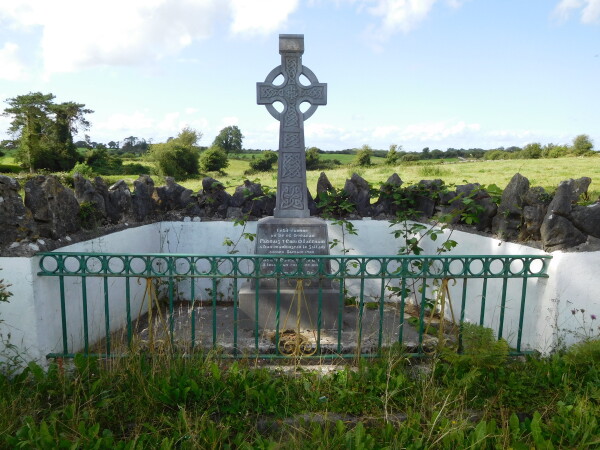
Figure 1. Celtic cross memorial beside Moy O’Hynes’ Wood, Carrowgarriff North, Raheen, County Galway. Photo Credit: Mark McCarthy
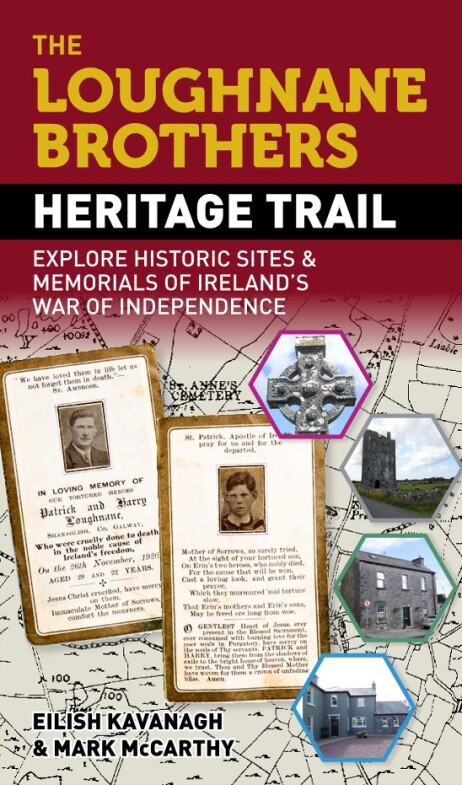
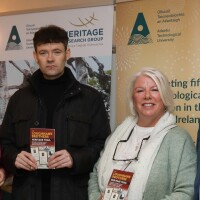
In 2022, the Heritage Research Group at Atlantic Technological University (ATU) collaborated with the Heritage Office at Galway County Council on the making of The Loughnane Brothers Heritage Trail: Explore Historic Sites & Memorials of Ireland’s War of Independence (Figure 2 & main image).
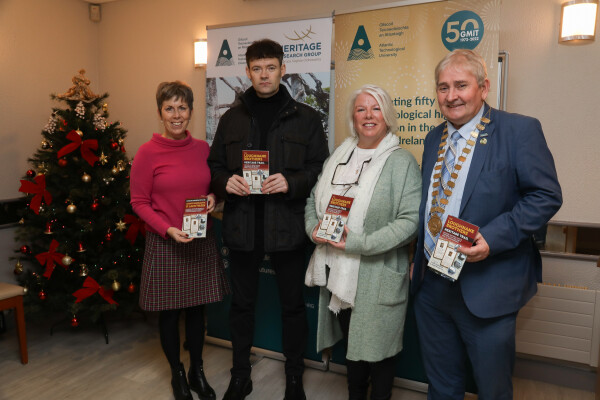
Figure 2. Pictured at the launch of The Loughnane Brothers Heritage Trail at Atlantic Technological University on 12 December 2022 are (L to R): Dr Orla Flynn, President, ATU; Dr Mark McCarthy, co-author, Senior Lecturer & Programme Chair in Heritage, ATU Galway City; Dr Eilish Kavanagh, co-author, ATU Heritage Research Group; and Cllr Michael (Moegie) Maher, Cathaoirleach of the County of Galway. Photo Credit: Aengus McMahon
Combining the methods of public history, historical geography, and heritage studies, the trails draw together varieties of tangible evidence by geolocating, photographing, recording, and mapping historic sites and memorials to the Loughnanes in south County Galway. Descriptions, photographs, and SAT NAV coordinates are included for eleven points of interest along the trails, as are route maps. The heritage trail starts in Shanaglish and ends in Kinvara, with stops along the way at Gort, Labane, Drumharsna, and Raheen. The eleven points of interest are as follows: (1) Site of the former residence of the Loughnanes, Shanaglish – where the brothers were abducted on 26 November 1920; (2) Former Royal Irish Constabulary Barracks, Gort – where the brothers were questioned and beaten; (3) Drumharsna Castle – where the brothers may have been incarcerated; (4) Celtic cross memorial beside Moy O’Hynes’ Wood – where the brothers were killed; (5) Turlough at Owenbristy – where the bodies were discovered; (6) Site of the former residence of the Hynes family, Kinvara – where the bodies were waked; (7) St Coleman's Church, Kinvara – the location of the Removal Mass; (8) St Anne’s Church, Shanaglish – the location of the Funeral Mass; (9) Grave of the Loughnane brothers, New Cemetery, Shanaglish – where the bodies were buried on 6 December 1920; (10) Quinn-Loughnane Hall, Labane – which opened on May 1941; and (11) Loughnane forge and remembrance park, Shanaglish – the forge of another brother, Hugh Loughnane (restored in 1996) and remembrance park (opened on 28 March 2016). The driving distance between the eleven points is approximately fifty kilometres and the driving time amounts to over an hour. Allowing for sufficient time to explore each point of interest, with time for breaks factored in as well, it is recommended that visitors allocate a full day to exploring the heritage along this trail.
The late Professor John A. Murphy once said that ‘communities everywhere honour their past, for there is no fulfilment in the present or confidence in the future unless there is reverence for the past’. (Ref 2) Notwithstanding the unceasing tussle between memory and forgetting, we believe that research in the humanities can bridge the gap between the past and present, and help with safeguarding Ireland’s revolutionary heritages in the future. It is our hope that The Loughnane Brothers Heritage Trail will serve as a worthwhile legacy initiative of the Decade of Centenaries and be of interest to anyone wishing to learn about the rich mosaic of historic sites and memorials that constitute the heritagescapes of the revolutionary era.
References
- E. Kavanagh and M. McCarthy, The Loughnane Brothers Heritage Trail: Explore Historic Sites & Memorials of Ireland’s War of Independence (Galway County Council & ATU Heritage Research Group, Galway, 2022).
- Oration by John A. Murphy, Professor of Irish History, University College Cork at the Annual Michael Collins Commemoration at Béal na mBláth, County Cork, 1982, in Béal na mBláth Commemoration: Ninetieth Anniversary. 1922–2012 (Béal na mBláth Commemoration Committee, Cork, 2012), p. 69.
Dr Elish Kavanagh works at the Central Statistics Office and is a Producer/Presenter of Kinvara FM’s podcast, Scattered Showers. She completed a PhD thesis at Atlantic Technological University in 2022, titled: The Irish War of Independence (1919–1921) in County Galway: Compiling Local Histories, Recording Memories & Developing Post-Conflict Heritage Initiatives. This was funded by the Irish Research Council’s Government of Ireland Postgraduate Scholarship Programme.
Dr Mark McCarthy is Senior Lecturer and Programme Chair in Heritage at Atlantic Technological University (ATU) and a Principal Investigator with its Heritage Research Group. His research interests include cultural heritage studies, urban historical geography, and the memory and commemoration of rebellions and wars in post-conflict contexts. He has been serving as a member of the Irish Humanities Alliance (IHA) Board since 2025.
Published: 28 Jul 2026 Categories: History, Decade of Centenaries, Visual and Material Culture, Cultural Studies