
In the preface to his 1989 volume of critical essays and reviews, The Figure in the Cave, John Montague remarked:
"what is regarded as envy is often dismay at disproportionate success, which fuels still further the paranoia of the neglected. It may be hard to realize it now, but when I was starting out all Irish poets were in a state of stunned isolation, except for Louis MacNeice….So many of my earlier essays were strategic attempts to get respected elders back into print, to recreate a fertile context." (x)
Much is packed into these few lines. A hint perhaps of his mixed feelings about Seamus Heaney and his outsized achievements and recognition, and also of the changed circumstances that marked Montague’s time of setting out as a poet and where Irish letters found themselves in the last decade of the twentieth century. But there is also the sense of filial duty, of the need to recover lost or neglected voices and to identify and revive a tradition.
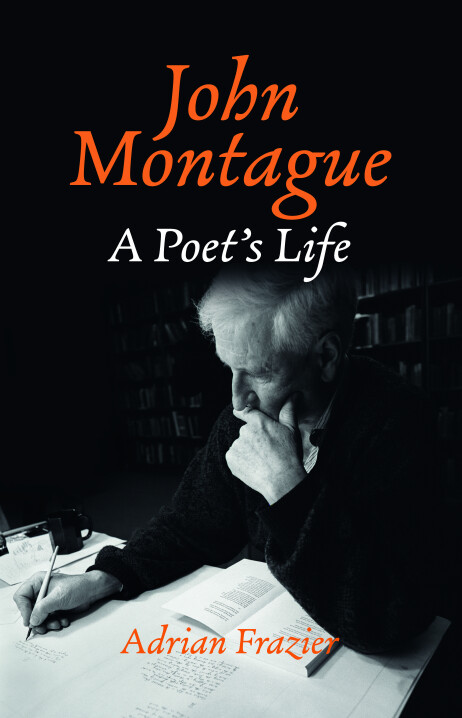
The same sense of purpose animates Adrian Frazier’s remarkable biography, John Montague: A Poet’s Life (Lilliput). Frazier takes us through the dynamic world that was the making of the poet and man of letters, who lived from 1929-2015. Montague’s relentless search for meaning in the past, the care and attention to local scenes and people, came from a source far deeper than nostalgia. As he put it in a remark quoted by Frazier:
"I harrow up my lineage, first because they haunt me, and to create a work of art is a form of exorcism: they become separated and permanent forms. Also, secondarily, [this represents] a form of self-understanding. But no urge to escape….The Presences for me are not a man-trap, but Fates, Inevitabilities." (124)
Frazier provides a convincing account of the impact of family separation in Montague’s childhood and the peculiar effects of being raised by two maiden aunts in Garvaghey, Co. Tyrone, while his two elder brothers enjoyed his mother’s attention nearby in Fintona (the father remained behind in Brooklyn). The influence, he suggests, extends to Montague’s complex marital and sexual history. (If there was a volume that brought his work all together it might be called Irresponsibilities). Frazier doesn’t shirk from this, avoiding the opposing pitfalls of apologist and scold.
Then there is the primal scene of Montague’s acquired stammer, a challenge that bedevilled him throughout his life. Montague traced it variously – sometimes to the strange moment of meeting his mother, as a child, when she returned from Brooklyn to Ireland, and re-entered his life, alarmingly, and sometimes to a traumatising occasion when he was required as a child to read aloud to his class at Garvaghey School and found himself unable to summon the words. Frazier writes very well about the after-effects and the career hazard facing a man who professionally needed to share his work with public audiences:
"Those accumulated debacles on stage in crowded theatres took a toll. The instantaneous reversal of fortune, from the anticipated celebration of the ego to imprisonment within a parody of himself, from printed eloquence to sounds spitting unintelligibly from his lips, repeated time and again from past nightmares – it was hideous, ruinous, pitiful. When he was eighty-seven years old, he had to admit it had been so." (37)
Seeing him in Youtube clips, one is struck by the fact that even his eyelashes had a stammer.
As much as this is a history of an individual and his formation, it is also a cultural history. Montague had an amazing talent for making contact with key figures and finding himself at historical flashpoints. He was in Yale with Harold Bloom in the 1950s, and studied there under Robert Penn Warren among other luminaries. At an Indiana summer school that he attended there were yet more eminent figures on the staff: Leslie Fiedler, Richard Wilbur, and William Empson. Another teacher, John Crowe Ransom, suggested that he seek a place at the Iowa Writers’ Workshop, where his classmates included Robert Bly, W.D. Snodgrass, Philip Levine, James Dickey, and Donald Justice. John Berryman was an instructor. He was in San Francisco in 1955 for the famous inaugural reading of the Beats that featured Alan Ginsberg’s recitation of Howl. He was in Berkeley in the 1960s where he experienced another ferment, and then back in Ulster as civil rights campaigning and the Troubles began. He was in touch with an astonishing array of seminal figures including Beckett, William Carlos Williams, and of course his friendships and rivalries with Kavanagh, Kinsella, Mahon, Kennelly, among many others.
This brings us to an unavoidable theme, what we might call Heaney Agonistes. It doesn’t take much effort of imagination to appreciate how hard it would have been, as a senior poet who broke new ground, to find a writer ten years his junior absorbing all the praise for tilling a similar patch. Frazier handles this issue brilliantly, in part by avoiding becoming transfixed by it. He points out Heaney’s borrowings, the quiet acknowledgements he made, and ultimately their reconciliation.
For all his good fortune in friendships and the stimulus of interesting times and places, Montague suffered from ill-luck in a number of his publishing ventures. A moment of career-defining redemption was the appearance of his Collected Poems in 1995. But even then, he was bedevilled by timing.
When they [Montague and his third wife, Elizabeth] walked down Dawson Street, copies of the Collected Poems filled the windows of Hodges Figgis on the left and Waterstone’s on the right. They returned to the Shelbourne Hotel to have a celebratory drink. At the bar, Elizabeth ran into John Hurt’s partner, Sarah Owens. She said, ‘Have you heard the news? Seamus Heaney has been awarded the Nobel Prize.’ John took it calmly, but it was terrible news for him. When the two went back down Dawson Street, all the copies of the Collected Poems had been removed from the display windows, to make room for titles by Seamus Heaney. (361)
Another side of the cultural story is the role of alcohol in the literary scene. The bar bill of this book would rival the national debt. (Montague, it seems, was rather adept at avoiding his turn when it came to buying rounds.) And there is the relentless masculine strain of the literary scene, no doubt abundantly clear at the time, but even more conspicuous in retelling anecdotes and encounters that animated the period (Frazier notes at one point, that “Literary performance became a male sport, a trial-by-contest where there had to be losers” (148)). The figure of Robert Graves appears often in the story, admonishing male poets with the dubious advice that success in poetry came through the pursuit of female muses. Montague was one among many who listened to him.
Yet what holds us is the tenacious grasp of Montague’s poetry, quoted frequently throughout and read with great insight by Frazier. He has a superb knowledge of poetic technique and writes well about Montague’s influences and engagements, not only American but also French. The language, voice, and cadence of the work remain compelling and urge our attention. The distinction between major and minor still holds in poetry, and Montague is unmistakably in the category of the former. We can also glimpse the relations between his poetry and prose, the short stories and his verse imagination which is rooted in situation as much as imagery.
All lives come to a conclusion. In reflecting on Montague’s, one is struck by the determination, as he once put it, “not to refuse experience, but to face it” (122). The intimacy and honesty of his work give it a powerful authenticity, while also representing a paradoxical liability. In a small country his reputation has been swamped by stories of his transgressions. Do we ask the same questions of authors elsewhere? What are our responsibilities as readers, as citizens? Perhaps this is the small parish reality of Ireland. The story of Heaney, for his part, may be as much his ability to manage his reputation as it is his poetry.
There is something redemptive in this book about Montague, and a final invitation to return to the poetry. Not only that, but to the period itself. For Frazier, he participated in an era of greatness to be marvelled at, one that rivals the Elizabethans, Metaphysicals and Romantics (396). Now that is something to ponder.

Daniel Carey is Secretary of the Royal Irish Academy and Established Professor of English at the University of Galway. He was chair of the Irish Humanities Alliance 2014-16. He serves on the board of the IHA as a representative of the RIA.
Published: 26 Nov 2025 Categories: Book reviews