
The Desert Island Dress project benefits from the cross-disciplinary perspectives of its two leads, Dr Dee Duffy and Katriona Flynn. Katriona comes from a fashion design background, with deep knowledge and appreciation of materials, fabrics, craftsmanship and design. Dee’s research interests, meanwhile, stem from the sociological perspectives of clothing – why we wear what we wear, and what clothing might say about us, both individually and socially. We taught together on a fashion buying masters at TU Dublin for several years, and enjoyed the alternate perspectives our respective disciplines brought to discussions on clothing and fashion.
One day in the office, Katriona mentioned an article she was writing, The Story of a Dress [1]. As we talked about the concept, we realised that there was something more that could be explored in our shared interest of the stories clothing can tell. Drawing on Dee’s experience in podcast production, and Katriona’s creative direction in brand concept and delivery, we conceived Desert Island Dress as an oral storytelling podcast. In May 2024, we launched the first series, kicking off with one of Ireland’s beloved drag queens, Davina Devine. Now in its fourth series, the podcast is available on all major platforms, freely accessible for all to listen to a growing back catalogue of guests including dress historian Hilary O’Kelly, Financial Times fashion editor Jo Ellison, fashion designer Peter O’Brien and Irish playwright Enda Walsh.
Strategically, our guests are from a cross-section of disciplines to reflect the all-encompassing reach of clothing, and the significance it holds in our lives. Each guest is asked to bring four items of clothing to the conversation, clothing that they’d simply have to take with them should they be banished to a deserted island. As Eoghan O’Sullivan of The Irish Examiner [2] noted in his review of our podcast, while the concept may not be entirely original, he follows with a welcomed compliment: ‘what’s striking about the show is just how revealing it is … a surprisingly intimate show’. We’ll take it! As such was our objective. To bring out the deeper significance of clothing, often trivialised in wider discourse.
What differentiates the series from most podcast formats, and reveals us as academics, is in the subsequent post-analysis episode after each guest interview. Here, we reflect on the chosen garments and explore themes raised in the conversation. For example, when photographer Rich Gilligan selected his Levi’s jeans, our follow up episode examined cultural myth-making and the power of iconic brands. And when Dublin-born musician Gavin Friday selected his homemade, four-yard black and white skirt from the 1970s, this garment sparked a discussion around masculinity and youth culture, and how clothes can be weaponised against older generations as a form of rebellion. Several of these reflective episodes have since been reworked and published as written articles by RTÉ Brainstorm [3].
A key objective of this project is to apply a more critical lens to the subject matter of clothing, and to do so in an engaging way. We were recognised for this work at the end of 2024, winning the Special Award for Design Education and Research, at the Institute of Designers in Ireland (IDI) Awards. Reviewer feedback reassured us we were on the right track, as they noted Desert Island Dress resources to be ‘entertaining and impactful, as well as meaningful beyond the classroom’. Our ambition is to bring academically-informed ideas surrounding the cultural significance of clothing to a wider audience, while staying current and connecting theoretical concepts with popular culture.
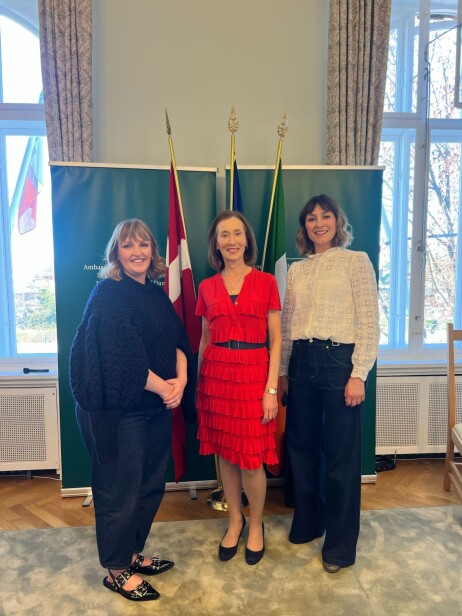
Our next goal was to expand the project beyond oral conversation (podcasts) and written analysis (articles) into a live event experience, with real-time engagement and audience participation. This opportunity came in April 2025, when Ambassador Elizabeth McCullough invited us to collaborate with the Embassy of Ireland in Denmark to host The Fabric of Us: Clothing, Identity and Meaning in Copenhagen. The format included a panel discussion with Irish creatives living in Copenhagen including fashion designer Caoimhe Dowling and architect/designer, Tom Dowling. This was followed by a fireside chat with Copenhagen Fashion Week COO, Dublin-born Isabella Rose Davey. While we were excited to speak with these wonderful guests, what took us by surprise was the collective energy in the room. During the Q&A, attendees began producing beloved garments they had brought, eager to share their stories! Guests shared beautiful stories of wedding dresses, a grandfather’s cherished hat, and another lady modelled a little red Charleston dress she handmade at 15 years of age, and even broke out into a spontaneous Charleston dance for the room! There was immense fun and connection happening, with a former Danish fashion designer even coaxing the Ambassador to showcase his fur-trimmed bolero as he retold the story behind the creation, originally designed for a royal banquet.
Each garment, which could be dismissed as, “just clothes”, or “just fashion”, were loaded with emotion, memory and narrative. And in that room for a few hours, strangers connected deeply in the collective joy or sometime loss, that each item and memory rekindled.
We say “just”, as since starting this project we have learned from an earlier guest, Irish Times fashion editor, Deirdre McQuillan, that textiles, design and craft are not recognised as valued components of “the arts”, under the Arts Act 2003. McQuillan wrote an opinion piece last year highlighting how Irish fashion designers are making waves globally, yet their cultural contribution is not being recognised at home. Designers such as Jonathan Anderson, Simone Rocha and Róisín Pierce are all namechecked as ambassadors of Ireland, showcasing this country and its skills in fashion and textiles, yet at home, their own arts council does not recognise their cultural custodianship. Why are Ireland’s globally acclaimed designers not considered part of Ireland’s cultural output?
Could it be that fashion just isn’t considered high-brow enough? Perhaps it does not have the same cultural caché as poetry, literature, or fine art has acquired? Indeed, in researching and teaching fashion, we have experienced first-hand how it can be dismissed as a more frivolous area of study. And this could be the crux of the issue for fashion, as recent guest of the podcast, Professor Angela McRobbie posed rhetorically and with irony, ‘how can you be a fashionista and a serious feminist intellectual’? [4] In this conversation, McRobbie shares stories from her early scholar days at the Birmingham Centre for Contemporary Cultural Studies (BCCC), where she worked with cultural theorists such as Stuart Hall and Richard Hoggart to legitimatise their critical cultural studies research. And although McRobbie started researching female-dominated cultural domains over four decades ago, she still notes that the fashion domain continues to bring ‘negativity and criticism and being denigrated really as less serious’.
In terms of the Arts Act 2003, we are intrigued to know who these cultural gatekeepers were nearly a quarter of a century ago, and if they still stand over their conviction. Designers like Caoimhe Dowling currently rely on Danish government grants for financial support, as the Irish Arts Council excludes fashion design from arts funding. Could it be time to reconsider fashion not simply as commercial practice, but as a cultural practice and a vital component of Ireland’s cultural heritage?
These are just some of the questions unearthed in our Desert Island Dress project so far. With 2026 around the corner, we remain committed to building momentum, making an impact, and enjoying the process along the way.
Notes
[1] The Gloss. “The Story of A Dress: A Royal Visit, A Wedding Dress and Mum’s Covetable Wardrobe.” The Gloss. https://thegloss.ie/the-story-of-a-dress-a-royal-visit-a-wedding-dress-and-mums-covetable-wardrobe/.
[2] Eoghan O’Sullivan, “Podcast Corner: Desert Island Dress Offers Intimate Chat on Favourite Garments,” Irish Examiner, April 7, 2025, https://www.irishexaminer.com/lifestyle/artsandculture/arid-41608603.html.
[3] Dr Dee Duffy and Katriona Flynn, “How Beyoncé Rebranded Levi’s Jeans for a New Generation,” RTÉ Brainstorm, July 31, 2025, https://www.rte.ie/brainstorm/2025/0731/1503768-levis-jeans-launderette-ads-branding-beyonce/; Dr Dee Duffy and Katriona Flynn, “Why Men Have Always Worn Dresses as a Way to Rebel,” RTÉ Brainstorm, November 17, 2025, https://www.rte.ie/brainstorm/2025/1117/1543777-men-dresses-skirts-virgin-prunes-fontaines-dc-fashion-desert-island-dress/
[4] Dr Dee Duffy and Katriona Flynn, “Professor Angela McRobbie: The Social Life of Clothes,” Desert Island Dress, podcast audio, [December 9, 2025]
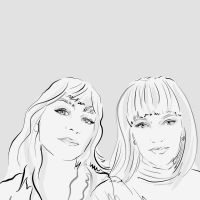
are lecturers at the Technological University Dublin. Authors image - a sketch by fashion illustrator Louise Boughton.
Published: 8 Dec 2025 Categories: Visual and Material Culture